
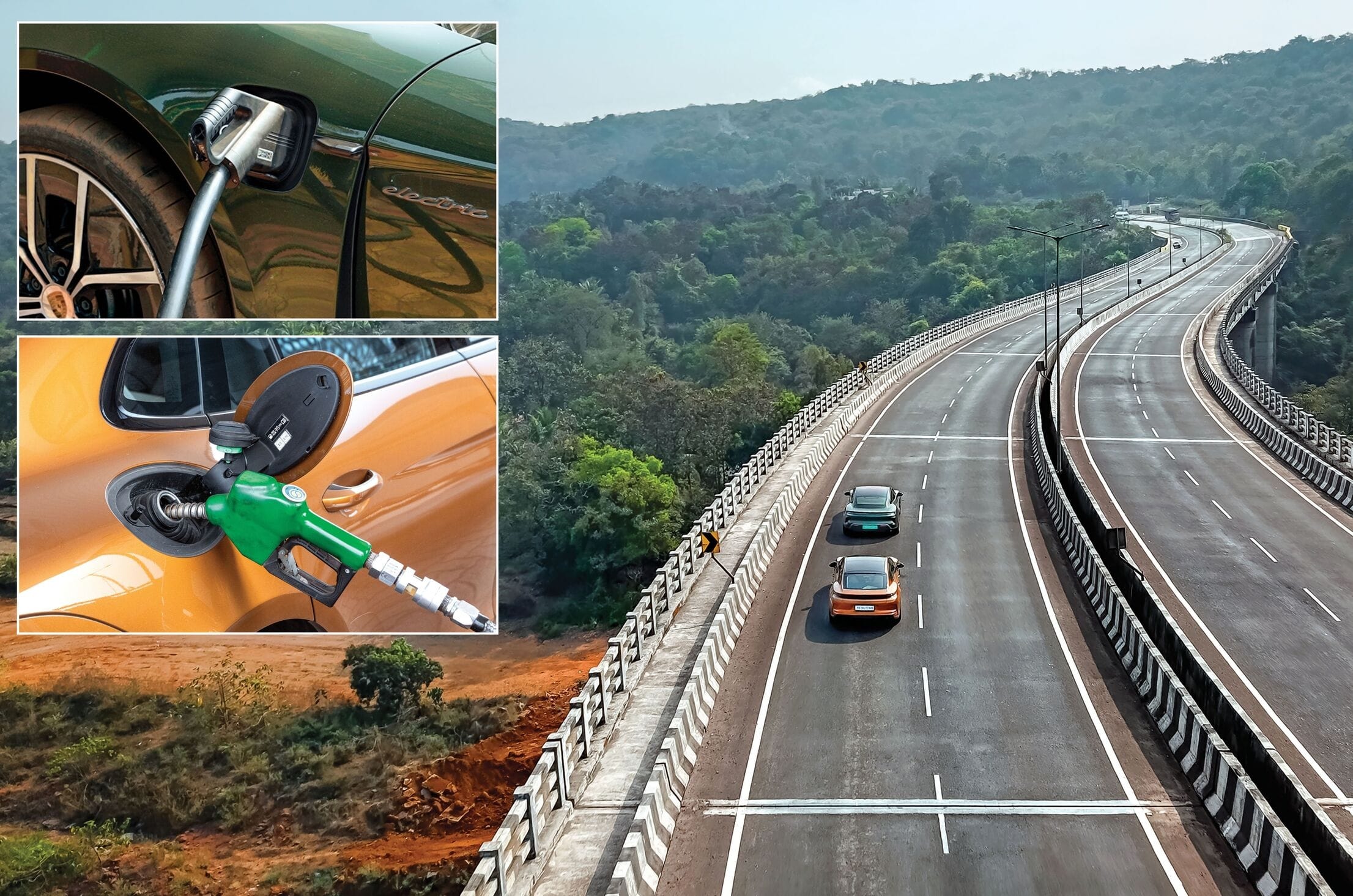
In the rapidly evolving landscape of automotive excellence, few questions spark as much debate among petrolheads and tech enthusiasts alike as the ultimate road trip machine. Can an all-electric supercar truly stand toe-to-toe with its roaring, petrol-guzzling sibling on the challenging, yet picturesque, highways of India? We set out to answer this very question, pitting two automotive titans from Stuttgart – the Porsche Taycan Turbo and the Porsche Panamera GTS – against each other on a classic Indian journey: the Mumbai to Goa road trip. Prepare for a compelling narrative where raw power meets electric sophistication, and where the future of mobility squares off against the revered legacy of the internal combustion engine. Just a few years ago, the very idea of traversing India in an all-electric vehicle was met with a mix of awe and skepticism. We ourselves embarked on an epic Kashmir to Kanyakumari journey in a standard Porsche Taycan back in 2022 – a Herculean 4,400km quest that was as exhilarating as it was nerve-wracking. That adventure, a testament to the Taycan's capability, also underscored the nascent, 'still developing' nature of India's EV charging infrastructure. Fast forward four years, and the wanderlust, a fundamental part of any automotive journalist’s DNA, called again. This time, however, we aimed for something more *relatable*, a road trip that reflects the aspirations of a broader audience: the iconic stretch from Mumbai to Goa. It's a route steeped in scenic beauty, unpredictable tarmac, and just the right amount of chaos to truly test a vehicle's mettle. A simple inquiry to Porsche India quickly escalated from a mere vehicle request into an irresistible proposition. The standard Taycan was no longer available, they informed us. Instead, we were offered the formidable Porsche Taycan Turbo. My attempt to feign disappointment was, admittedly, a spectacular failure. Then came the 'knockout punch': \"Would you also like the Porsche Panamera GTS?\" This wasn't a question; it was an unequivocal invitation to automotive nirvana. The plan instantly transformed: two distinct Porsches, one challenging route, and a singular objective – to determine which machine truly makes more sense for a quintessential Indian road trip. Our assessment would weigh performance, efficiency, running costs, and critically, the overall travel time. Does an EV genuinely introduce significant delays, or has the landscape shifted? For this epic showdown, I was joined by my seasoned colleague, Jay Patil, and our dedicated camera crew. Predictably, Jay, with a mischievous glint in his eye, immediately laid claim to the Taycan's keys, deftly stowing his bag into its cavernous frunk as if he'd orchestrated this moment since birth. I offered no resistance, for I had the privilege of commanding the Panamera GTS, resplendent in a striking Madeira Gold finish. More importantly, nestled beneath its elegant hood was a beast: a 4.0-litre twin-turbo V8, churning out a staggering 500hp. The cold start alone, an orchestral eruption echoing through the quiet office parking lot, served as a visceral warning shot – this was destined to be an unforgettable day. Both machines were primed for their respective battles: the Taycan fully charged, the Panamera brimming with petrol. Our route was set by Google Maps: the gleaming Mumbai Trans Harbour Link (Atal Setu), leading us onto the venerable NH66. The alternative via Pune and Kolhapur, while familiar, would have added precious hours – an indulgence we simply couldn't afford with two performance Porsches at our disposal. In the pre-dawn stillness of Mumbai, the city slumbered, leaving the roads remarkably empty. This was our playground, and a wide, conspiratorial grin spread across my face. The Panamera’s V8 doesn't merely accelerate; it orchestrates a symphony of power. There's a fractional pause, a gathering of its formidable strength, before it unleashes a sledgehammer blow, thrusting you down the road with dramatic theatricality. It’s an intoxicating, deeply addictive experience. Yet, even as I reveled in the glorious cacophony, something remarkable, almost unsettling, occurred. The 884hp Taycan Turbo simply *vanished*. No roaring exhaust, no mechanical drama – just pure, relentless, almost silent acceleration. I was pushing the Panamera to its limits, flat out, and the Taycan effortlessly pulled away, as if I’d inexplicably fumbled a gear. This was my first, profound reality check of the day: electric performance is a different beast entirely. Of course, the pristine tarmac of the Atal Setu quickly gave way to the quintessential Indian highway experience. NH66, while vastly improved in many sections, still reserves its surprises: the completely random, utterly baffling speed breakers. Both Porsches, despite their sophisticated adaptive air suspension systems, were forced to crawl over these undulations like cautious house cats. It's a reminder of the unique challenges of Indian road design, where engineering marvels meet unexpected, localized obstacles. Once the road unfurled again, the true dynamic capabilities of both cars began to shine. Freshly laid stretches, minimal traffic, and serious power on tap meant we were devouring kilometers with impressive speed. The Panamera, with its effortless cruising ability, perfectly weighted steering, and unshakable high-speed stability, felt utterly at home. Around 170km into our journey, near Poladpur, we encountered a tantalizing stretch of twisties. Game on. I pushed harder, braked later, carried more speed into the corners, convinced this would finally expose the Taycan’s supposed weaknesses. Yet, there Jay was, resolutely clinging to my mirrors, annoyingly composed, seemingly unfazed in the Taycan. It defied conventional wisdom; an EV, inherently heavier due to its battery pack, should not be able to match the agility of a finely tuned ICE sports sedan through corners. Yet, the Taycan’s low center of gravity and instant torque vectoring were rewriting the script. Reality, however, is rarely a continuous ribbon of smooth tarmac. Construction zones, broken patches, and seemingly endless diversions soon interrupted our spirited pace. In these segments, the Porsche Panamera GTS’s impressive ground clearance, aided by its adjustable air suspension, proved invaluable, as did the Taycan's suspension lift function, earning its keep as we navigated the less-than-perfect surfaces. Just over 300km into our journey, Jay, ever the planner, suggested a lunch stop. This wasn't a random culinary detour; it was a strategically scouted location identified via the PlugShare app, equipped with a 60kW Zeon DC fast charger. Coincidence? Absolutely not. The timing, fortunately, aligned perfectly with my rumbling stomach. To our relief, no other EV occupied the charging bay, and the Taycan connected without a hitch, immediately pulling power at a peak of 58.5kW. At this point, its battery had depleted to 72 percent. Forty minutes later, as we polished off our lunch, the Taycan's State of Charge (SoC) had rebounded impressively to 62 percent, displaying a projected range of 320km – more than ample to reach our Goan destination. Meanwhile, the Panamera, blissfully unaware of kilowatt-hours, was still happily guzzling fossil fuels. A couple of hours later, however, its fuel light flickered to life. But the solution was instant: a mere four minutes later, 78 litres of petrol had vanished into its tank, and we were back on the road. This stark contrast in \"refueling\" times was illuminating. It was then that Jay suggested a car swap. I hesitated, briefly, then surrendered the keys. The moment I settled into the Taycan's driver's seat, I understood Jay's eagerness to switch. The Taycan's panoramic glass roof, devoid of a sunshade, had transformed the cabin into a veritable solar oven under the relentless Indian sun. While the air-conditioning valiantly fought back, the sun was undeniably winning the thermal battle. Yet, the instant my foot pressed the accelerator, all discomfort evaporated. This machine is utterly insane. \"Explosive\" barely scratches the surface. The acceleration is instant, violently potent, and borderline comical in its ferocity. It simply *launches*, again and again, with no sense of mechanical strain, just pure, unadulterated electric fury. But what truly captivated me was its holistic brilliance. The steering felt sharper, more precise than the Panamera's. Despite its considerable weight, the Taycan felt surprisingly agile and light on its feet. The braking was stronger, more confidence-inspiring, instilling a sense that Porsche had quietly, yet definitively, rewritten the rules of what an electric sports car could be. Just as we settled into a harmonious rhythm, the road, ever mischievous, threw us a curveball. A tyre pressure warning illuminated the dash. We immediately pulled over, fortuitously spotting a roadside puncture repair shop just ahead. Engaging \"Car Jack mode,\" a crucial feature that raises the vehicle and stiffens the air suspension for safe lifting, the car ascended, revealing the culprit. It wasn’t a mere nail. It wasn't a screw. It was a two-inch bolt! Naturally, it had to be something spectacular to add an extra layer of excitement and a touch of negative PR to our otherwise smooth narrative. Such are the joys and unpredictable challenges of road tripping in India, where even the most meticulously engineered machines can fall prey to unforeseen debris. Crisis expertly managed, we resumed our journey. The final stretch was nothing short of glorious: fast sweepers, long straights, and blessedly light traffic. It was the kind of road that allows you to truly immerse yourself in the driving experience, letting the concerns of the world melt away. Several hours later – after ample photography sessions and a total distance of 546km – we finally rolled into the vibrant embrace of Goa. Now, for the cold, hard numbers that often dictate the practicality of such a trip. The Panamera GTS, with its potent V8, returned an average fuel efficiency of 5.88kpl, resulting in a total fuel cost just shy of Rs 9,700. Add to that Rs 250 for the Mumbai Trans Harbour Link toll. The Taycan Turbo, in stark contrast, consumed approximately 116kWh of electrical energy. At a commercial fast charging rate of Rs 28.20 per unit (inclusive of GST), this amounted to a total of Rs 3,271 – roughly a third of the Panamera’s running cost. Crucially, thanks to Maharashtra’s progressive EV incentives, the Taycan also incurred no toll charges on the MTHL. The financial disparity is undeniable. Was this a race? Not officially. Yet, the underlying question of travel time lingered. Here’s the revelation: with meticulous planning, intelligently timing charging stops to coincide with meal breaks or other necessary pauses, the Taycan could effortlessly match, and potentially even *beat*, the Panamera’s overall travel time. This single insight fundamentally alters the perception of long-distance EV travel in India. What this trip unequivocally proved is that long-distance EV journeys in India are no longer a risky gamble. The charging infrastructure, while still expanding, has vastly improved, battery technology has advanced significantly, and the dreaded \"range anxiety\" is rapidly fading into obsolescence. The roads, however, still have some catching up to do in terms of consistent quality. Having experienced both these magnificent machines firsthand on a challenging Indian road trip, a clear picture emerges of their respective strengths and weaknesses. This journey was more than just a road trip; it was a profound exploration into the heart of automotive evolution. I began this adventure with a clear bias, a deep-seated affection for the Panamera. My loyalty was to the visceral roar of the V8, the intoxicating drama, and the raw theatrics of internal combustion. But somewhere along the winding roads to Goa, amidst the quiet surges of power and the serene ease of covering vast distances, the Taycan Turbo quietly, yet decisively, won me over. Its performance isn't just outrageous; it's a paradigm shift. Beyond the sheer speed, it's the unparalleled refinement, the profound silence, and the effortless way it devours kilometers that truly stand out. The narrative of EV challenges, particularly in a developing market like India, is rapidly changing. What was once a daunting proposition is now a thoroughly viable, often superior, experience. The Taycan’s journey from Mumbai to Goa isn't just a testament to its engineering prowess; it's a beacon for the future of long-distance electric travel in India. And as for the drive back from Goa to Mumbai? There wasn’t even a debate. I reached for the key to the Porsche Taycan Turbo. And this time, I didn't give it back. The era of the electric road trip has not just arrived; it has, in the hands of Porsche, matured into an experience that can genuinely rival, and often surpass, the traditional petrol-powered adventure. The future, it seems, is exhilaratingly electric.Porsche Power Play: Taycan Turbo vs. Panamera GTS – The Ultimate Mumbai to Goa Road Trip Showdown
The Genesis of a Grand Challenge: Mumbai to Goa, Electrified and Unleashed
The Contenders: A Clash of Philosophies on Asphalt

The Initial Sprint: V8 Roar vs. Electric Surge


Twisties and Tarmac: An EV's Unexpected Agility

The Charging & Fueling Conundrum: Time, Tech, and a Touch of Sunstroke


The Unforeseen Detour: A Bolt in the Wheel


The Numbers Game: Cost, Convenience, and a Paradigm Shift


Porsche Taycan Turbo vs. Panamera GTS: Pros & Cons for an Indian Road Trip
Porsche Taycan Turbo
Porsche Panamera GTS
The Verdict: A Shifting Paradigm, Quietly Conquered
