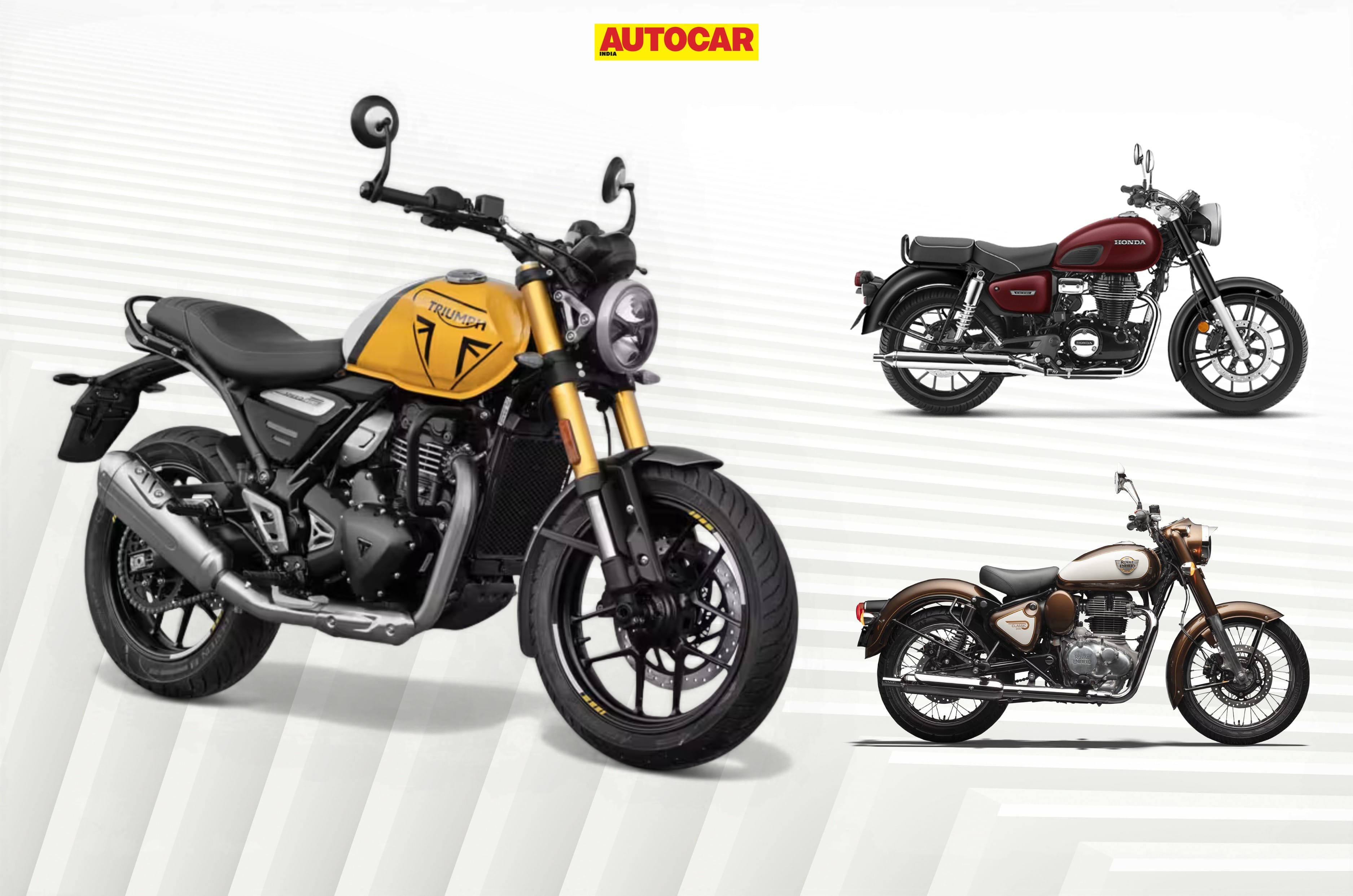
Triumph Speed 400 vs. Honda CB350 vs. Royal Enfield Classic 350: A Bare-Knuckle Battle for Middleweight Supremacy
The motorcycle landscape in the thriving 350cc-400cc segment has always been fiercely contested, a veritable gladiatorial arena where heritage, performance, and value clash head-on. For years, this space was largely dominated by stalwarts like the Royal Enfield Classic 350, a machine steeped in history and a distinctive thumper charm. Honda then made a formidable entry with its CB350 H'Ness, introducing Japanese refinement and modern reliability to the retro-classic fold. Now, a new challenger has emerged from the hallowed halls of Hinckley, a name synonymous with premium motorcycling: the Triumph Speed 400.
Triumph's strategic decision to re-engineer its 400cc platform down to a 349cc displacement isn't just a technical tweak; it's a calculated maneuver that has fundamentally reshaped the competitive dynamics. This isn't merely about numerical parity; it's about sliding into a lower GST bracket, making a premium European brand surprisingly accessible. But does this \"downsizing\" dilute the essence of Triumph, or does it deliver a knockout blow to its established rivals? We delve deep into the specifications, dissecting every aspect to determine how these three middleweight titans compare on paper, and what it truly means for the rider on the street.
Engine & Performance: The Power Play or The Torque Tug-of-War?
The Triumph Unleashes a Power Advantage, But Rivals Offer Low-End Charm
At the heart of any motorcycle comparison lies its powertrain, and here, the differences are stark. The Triumph Speed 400, despite its slightly reduced displacement of 349cc, represents a thoroughly modern engineering marvel. Its liquid-cooled, DOHC (Double Overhead Camshaft) single-cylinder engine is designed for high performance, a stark contrast to the air-cooled or air/oil-cooled SOHC (Single Overhead Camshaft) units of its rivals.
| |
Triumph Speed 400 |
Honda CB350 |
Royal Enfield Classic 350 |
Engine |
349cc, single-cylinder, liquid-cooled, DOHC |
348.4cc, single-cylinder, air-cooled, SOHC |
349cc, single-cylinder, air/oil-cooled, SOHC |
Power |
37hp at 8,500rpm |
21hp at 5,500rpm |
20.2hp at 6,100rpm |
Torque |
32Nm at 7,000rpm |
29.5Nm at 3,000rpm |
27Nm at 4,000rpm |
Transmission |
6-speed |
5-speed |
5-speed |
The numbers don't lie: the Triumph Speed 400 churns out an impressive 37hp at a peaky 8,500rpm, nearly double the power of its 350cc competitors. Its 32Nm of torque, while higher than the Classic 350, arrives at a relatively high 7,000rpm. This indicates a motorcycle that loves to be revved, delivering its best performance higher in the powerband. For riders seeking spirited acceleration and highway prowess, the Triumph is a clear front-runner.
In contrast, the Honda CB350 and Royal Enfield Classic 350 prioritize a different kind of performance. With 21hp (CB350) and 20.2hp (Classic 350) respectively, they are significantly less powerful. However, their peak torque figures of 29.5Nm (CB350) at a mere 3,000rpm and 27Nm (Classic 350) at 4,000rpm highlight their forte: exceptional low-end tractability. This translates to effortless city commuting, requiring fewer gear changes, and a more relaxed cruising experience, qualities deeply cherished by riders in this segment. The distinctive \"thump\" of the Classic 350's long-stroke engine, while not numerically superior, offers an unparalleled sensory experience that many riders actively seek.
Another critical differentiator is the transmission. The Triumph boasts a modern 6-speed gearbox, providing finer control over the power delivery and potentially better fuel efficiency at highway speeds. Both Honda and Royal Enfield stick to a 5-speed unit, which is adequate for their power characteristics but might feel less engaging for aggressive riding. Furthermore, the Triumph and Honda both feature a slip-and-assist clutch, a welcome addition for smoother downshifts and reduced lever effort, especially in stop-and-go traffic. While the Classic 350 traditionally missed out, it's worth noting that its siblings, like the Hunter 350 and the newly introduced Goan Classic 350, have received this upgrade, signaling that the Classic 350 itself might soon catch up, enhancing its riding convenience.
Dimensions, Ergonomics & Ride Dynamics: The Feel of the Road
The Triumph Takes the Lightweight Crown, Promising Agility
Beyond raw power, how a motorcycle feels and handles is profoundly influenced by its physical attributes. Weight, seat height, and overall dimensions play a pivotal role in rider confidence and comfort, particularly in diverse riding conditions ranging from urban commutes to weekend excursions.
| |
Triumph Speed 400 |
Honda CB350 |
Royal Enfield Classic 350 |
Kerb weight |
179kg |
186kg |
195kg |
Seat height |
803mm |
800mm |
805mm |
Ground clearance |
164mm |
NA |
170mm |
Fuel tank |
13 litres |
15.2 litres |
13 litres |
Wheelbase |
1,386mm |
1,441mm |
1,390mm |
The Triumph Speed 400 is the featherweight champion here, tipping the scales at just 179kg (kerb weight). This significant weight advantage, combined with its high power output, translates into a far superior power-to-weight ratio. Lighter motorcycles are inherently more agile, easier to maneuver in traffic, and more engaging on twisty roads. This characteristic alone can make the Speed 400 feel significantly more responsive and sprightly than its heavier counterparts.
The Honda CB350, at 186kg, strikes a good balance, feeling substantial but still manageable. The Royal Enfield Classic 350, however, is the heaviest of the trio at 195kg. While this weight contributes to its famed stability and big-bike feel, it undeniably impacts its agility, particularly in slow-speed maneuvers and while navigating congested urban environments.
In terms of accessibility, all three motorcycles offer remarkably similar seat heights, hovering in the low 800mm range. This makes them largely accessible to a wide range of riders, a crucial factor in markets where rider height can vary significantly. Ground clearance, an often-overlooked metric, is quite good for the Classic 350 at 170mm, which is beneficial for tackling uneven roads. The Triumph's 164mm is respectable, though Honda hasn't officially disclosed this figure for the CB350. A higher ground clearance offers peace of mind over speed breakers and potholes, which are unfortunately common realities in many regions.
Fuel tank capacity is another point of divergence. The Honda CB350 leads with a generous 15.2-liter tank, promising extended range for touring enthusiasts. Both the Triumph Speed 400 and Royal Enfield Classic 350 come with 13-liter tanks. While adequate for city use and shorter rides, longer journeys might necessitate more frequent fuel stops for the latter two. The wheelbase figures also offer insights: the Honda has the longest wheelbase (1,441mm), contributing to its stable, unhurried cruising demeanor, while the Triumph (1,386mm) and Royal Enfield (1,390mm) are slightly more compact, suggesting a marginally nimbler feel, especially for the Speed 400.
Chassis & Running Gear: The Foundation of Control and Comfort
Triumph's Premium Hardware Signals a Performance Edge
The choice of suspension, braking components, and tires fundamentally dictates a motorcycle's handling, ride quality, and safety. Here, the premium positioning of the Triumph becomes evident, leveraging more advanced hardware to deliver a distinct riding experience.
| |
Triumph Speed 400 |
Honda CB350 |
Royal Enfield Classic 350 |
Suspension (front/rear) |
USD fork / Monoshock |
Telescopic fork / Twin shock absorbers |
Telescopic fork / Twin shock absorbers |
Brakes (front/rear) |
300mm disc / 230mm disc (Dual-channel ABS) |
310mm disc / 240mm disc (Dual-channel ABS) |
300mm disc / 270mm disc (Dual-channel ABS) |
Tyres (front/rear) |
110/80-17 / 150/70-17 |
100/90-19 / 130/70-18 |
100/90-19 / 120/80-18 |
The Triumph Speed 400 truly shines in its running gear. It boasts a sophisticated suspension setup, featuring upside-down (USD) forks at the front and a monoshock at the rear. USD forks offer superior rigidity, better feedback, and more precise handling, particularly during aggressive riding and braking. A monoshock provides consistent damping and a sportier feel. This configuration is typically found on more premium and performance-oriented motorcycles, giving the Speed 400 a significant advantage in dynamic handling and cornering prowess.
In contrast, both the Honda CB350 and Royal Enfield Classic 350 employ a more conventional setup: telescopic forks up front and twin shock absorbers at the rear, often with adjustable preload. While this setup is proven, reliable, and perfectly adequate for comfortable cruising and urban commuting, it lacks the inherent stiffness and refined damping characteristics of a USD/monoshock combination. For riders who prioritize plush ride comfort over razor-sharp handling, the traditional twin-shock setup might even be preferred for its ability to soak up bumps with a certain old-school charm.
Braking systems across all three are disc brakes front and rear, coupled with dual-channel ABS, which is a commendable safety standard in this segment. The Honda CB350 features the largest front disc at 310mm, with a 240mm rear, while the Triumph and Classic 350 use 300mm front discs. The Classic 350, however, has the largest rear disc at 270mm, indicating robust stopping power. While on paper these differences might seem minor, real-world feel and progressive bite often depend on caliper design and master cylinder calibration, aspects that can only be truly judged during a test ride.
Tyre choices also highlight their intended purpose. The Triumph runs on a modern 17-inch alloy wheel setup both front and rear (110/80-17 front, 150/70-17 rear). This common wheel size offers a wide selection of performance-oriented rubber and contributes to sharper, more agile handling. The Honda and Royal Enfield, with their larger 19-inch front and 18-inch rear wheel combinations (CB350: 100/90-19 F, 130/70-18 R; Classic 350: 100/90-19 F, 120/80-18 R), lean into their retro aesthetics and offer a more stable, planted feel, particularly over broken surfaces. Their narrower rear tires also contribute to the classic silhouette but might offer slightly less ultimate grip compared to the Triumph's fatter rubber when pushed hard.
Pricing & Value Proposition: The Pocketbook Perspective
The Royal Enfield Remains the Affordability King, But Triumph Justifies its Premium
For many riders, the final decision often boils down to the price tag and the perceived value for money. This segment is particularly sensitive to pricing, as it caters to a broad audience, from first-time buyers to seasoned enthusiasts looking for a characterful daily rider. It’s here that Royal Enfield has traditionally held an unshakeable fort.
| Bike |
Price (ex-showroom) |
Royal Enfield Classic 350 |
Rs 1.86 lakh - Rs 2.21 lakh |
Honda CB350 |
Rs 1.97 lakh - Rs 2.00 lakh |
Triumph Speed 400 |
Rs 2.32 lakh |
The Royal Enfield Classic 350, with its wide range of variants offering different paint schemes and wheel choices, starts at an attractive Rs 1.86 lakh and goes up to Rs 2.21 lakh (ex-showroom, India). This makes it the most accessible entry point into the retro-classic segment and continues to be a major draw for budget-conscious buyers and brand loyalists.
The Honda CB350 positions itself slightly above the Classic 350, with prices ranging from Rs 1.97 lakh to Rs 2.00 lakh. Its pricing reflects Honda's reputation for refinement, reliability, and widespread service network, offering a more polished alternative to the Royal Enfield experience.
The Triumph Speed 400, on the other hand, commands a noticeable premium at Rs 2.32 lakh. While some might balk at the higher price, it's crucial to consider the substantial upgrades it offers: a significantly more powerful and technologically advanced liquid-cooled engine, sophisticated USD forks and monoshock suspension, a 6-speed gearbox, and the undeniable prestige of the Triumph brand. On paper, it largely justifies its price with superior hardware and performance metrics. However, the true test of value isn't just in the spec sheet but in the ownership experience, including service costs, parts availability, and long-term reliability – areas where Honda and Royal Enfield have established formidable reputations.
Pros and Cons: A Balanced Perspective
To help potential buyers navigate this exciting segment, let's break down the key advantages and disadvantages of each motorcycle:
Triumph Speed 400
- Pros:
- Significantly higher power and sportier performance for highway riding and spirited dashes.
- Advanced liquid-cooled DOHC engine and 6-speed gearbox for a modern riding feel.
- Superior suspension hardware (USD forks, monoshock) for sharp handling and stability.
- Lightest in its class, contributing to excellent agility and maneuverability.
- Premium brand appeal and quality finish.
- Cons:
- Highest price point among the three, a significant barrier for some.
- Power delivery is higher in the rev range, requiring more gear changes in city traffic.
- Newer entrant; long-term reliability and service network reach are yet to be fully established in all markets.
- Smaller fuel tank limits long-distance touring range slightly.
Honda CB350
- Pros:
- Exceptional engine refinement and smooth operation, a Honda hallmark.
- Strong low-end torque for effortless city riding and comfortable cruising.
- Largest fuel tank offers excellent range.
- Reputation for bulletproof reliability and extensive service network.
- Classic styling with modern touches like LED lighting and slip-and-assist clutch.
- Cons:
- Significantly lower power output compared to the Triumph.
- 5-speed gearbox feels less modern than the Triumph's 6-speed.
- Conservative styling might not appeal to riders seeking a more aggressive look.
- Suspension setup is more basic than the Speed 400's.
Royal Enfield Classic 350
- Pros:
- Unmatched retro-classic aesthetics and a distinctive \"thump\" that resonates with heritage enthusiasts.
- Most affordable option, making it accessible to a wider audience.
- Excellent low-end torque for relaxed riding, particularly on uneven roads.
- Robust build quality and a vast, well-established service and customization ecosystem.
- Strong resale value and enduring brand loyalty.
- Cons:
- Heaviest of the three, impacting agility and city maneuverability.
- Lowest power output and least refined engine, with noticeable vibrations at higher speeds.
- Most basic suspension and braking hardware (though effective).
- Lacks a slip-and-assist clutch in its standard form (though this may change).
- Older design philosophy, which some might find less engaging dynamically.
The Verdict: Choosing Your Two-Wheeled Companion
This head-to-head comparison reveals three distinct philosophies in the 350cc segment. The Triumph Speed 400 emerges as the clear winner on paper when it comes to outright performance, modern technology, and premium componentry. Its powerful engine, lightweight chassis, and sophisticated suspension make it a compelling choice for riders who prioritize dynamic handling, spirited acceleration, and a contemporary riding experience wrapped in classic styling. It challenges the established norms by bringing a truly \"premium\" feel to a relatively accessible price point, shaking up the market fiercely.
However, to dismiss the Honda CB350 and Royal Enfield Classic 350 would be a gross oversight. These motorcycles don't just exist; they thrive by offering qualities that the Triumph, despite its prowess, simply cannot replicate. The Honda CB350 excels in refinement, effortless low-end torque, and the unwavering assurance of Japanese reliability. It’s the perfect blend of retro aesthetics and modern usability, a gentleman's classic that glides through traffic and cruises highways with quiet competence.
The Royal Enfield Classic 350, meanwhile, remains the heartthrob for traditionalists. Its allure isn't just about specs; it's about an emotional connection to a legacy, the unmistakable thrum of its engine, and a design that is timeless. It offers the most accessible entry point and a vast ecosystem of support and customization. While less powerful and heavier, its relaxed riding dynamics and unpretentious character have cemented its place in the hearts of millions.
Ultimately, the \"best\" motorcycle among these three is highly subjective and depends entirely on individual rider preferences and priorities. Do you crave exhilarating performance and cutting-edge tech, even if it comes at a higher price and requires a more rev-happy riding style? The Triumph Speed 400 is calling your name. Do you value smooth, refined rides, impeccable reliability, and a classic demeanor that’s easy to live with day-to-day? The Honda CB350 is your ideal companion. Or perhaps you're drawn to the undeniable heritage, the iconic thump, and the sheer character of a machine that has stood the test of time, even if it means embracing a less frenetic pace? The Royal Enfield Classic 350 awaits.
Each of these motorcycles offers a distinct flavour in the burgeoning middleweight segment. The Triumph has undoubtedly raised the bar in terms of performance and hardware, forcing its rivals to adapt. But the deeply ingrained strengths of the Honda and Royal Enfield ensure that this battle for supremacy is far from over. The real world, beyond the numbers, will truly decide the victor for each rider. So, which one will you throw a leg over? The choice, as always, is yours.