
The automotive world frequently buzzes with acronyms and technical jargon, often leaving enthusiasts and prospective buyers navigating a labyrinth of information. Few topics stir as much discussion—and occasional confusion—as vehicle platforms. When Renault recently pulled the covers off its highly anticipated new Duster for the Indian market, a curious detail emerged: the SUV was proudly stated to be underpinned by the Renault Global Modular Platform (RGMP). This announcement immediately raised eyebrows, given its striking visual resemblance to the European model, which is famously based on the Common Module Family – B (CMFB) platform. Are these truly distinct entities, or merely a clever rebranding exercise? This article delves deep into the intricate differences and strategic motivations behind Renault’s decision to assign two distinct names to platforms that, at a glance, appear remarkably similar. Prepare to unravel the technical nuances, market strategies, and future implications of RGMP and CMFB.
At the heart of every modern vehicle lies its platform—a sophisticated architectural skeleton dictating everything from body structure and safety to powertrain compatibility and interior packaging. The concept of modular platforms, like Renault's Common Module Family (CMF), revolutionized vehicle development by allowing manufacturers to share a vast array of components across multiple models and segments, leading to economies of scale and faster product cycles. The CMFB platform, in particular, has been a stalwart for Renault-Nissan-Mitsubishi Alliance, underpinning popular models like the Clio and Captur in Europe. Its robustness and adaptability are well-documented.
The initial assertion that the Indian Duster would ride on an \"RGMP\" platform, despite its strong familial ties to the CMFB, sparked a healthy debate. Renault was quick to clarify that while the two platforms indeed share a significant amount of hardware—their foundational \"bones,\" if you will—the RGMP introduces a suite of critical distinctions that warranted its unique nomenclature. This isn't merely a superficial rebranding; it reflects a targeted evolution driven by specific market demands, technological advancements, and future-proofing strategies. Understanding these distinctions is key to appreciating Renault's long-term vision for its global product portfolio, particularly in high-growth markets like India.
While the mechanical underpinnings of RGMP derive substantially from the CMFB platform, Renault has orchestrated a profound transformation in its electrical and electronics (E&E) architecture. This is perhaps the most significant differentiator. Gone is the previous E&E system, replaced by a cutting-edge, entirely new architecture dubbed SWEET400 (SoftWare Electric and Electronic Technology). This isn't just an incremental upgrade; it's a quantum leap, co-developed with none other than Google. As Francisco Hidalgo, VP Sales & Marketing, Renault India, articulated at a recent tech presentation, \"The E&E here is more advanced and capable of hosting many of the latest technologies.\"
The implications of this collaboration are far-reaching. One prime example is the seamless integration of the Google Automotive System. This goes far beyond a mere infotainment screen running Android Auto; it's a deeply embedded operating system that integrates the entire dashboard and core vehicle functions. We're talking about HVAC (heating, ventilation, and air conditioning), central locking, driver profiles, and even personalized drive modes. Imagine signing in with your Google ID, and not only are your playlists and Google Maps data instantly accessible, but the car also automatically adjusts to your preferred climate settings, seat positions, and even sophisticated ADAS (Advanced Driver-Assistance Systems) configurations. In essence, while RGMP might share its skeletal structure with CMFB, its entire neural network and operational intelligence are brand new, highly sophisticated, and intrinsically connected to a global tech ecosystem.
However, this deep integration, while offering unparalleled convenience and personalization, isn't without its potential drawbacks or, as some might view it, a double-edged sword. The increasing reliance on a third-party tech giant like Google for fundamental vehicle operations raises questions about data privacy and ownership. How much driver data is collected, how is it used, and who ultimately controls it? Furthermore, the complexity introduced by such advanced software architectures means potential vulnerabilities to cyber threats, requiring robust and continuous over-the-air (OTA) updates—a capability that SWEET400 is designed for, but one that also places significant responsibility on the manufacturer for long-term support. While cutting-edge, the universal appeal of such deep digital integration for all demographics remains to be fully seen; some traditionalists might prefer a simpler, less interconnected driving experience.
Beyond the electronic brain, RGMP also features significant modifications to its physical architecture. Dr. Vikraman V, Chief of Renault Engineering at Renault Group India, highlighted a crucial difference: \"this platform has been engineered to build sub-4-meter cars comfortably, which was not the case with CMFB.\" This statement underscores a strategic imperative for markets like India, where sub-4-meter vehicles benefit from significant tax incentives, making them more affordable and highly competitive. The CMFB platform was primarily conceived to underpin larger B-segment cars, often exceeding the 4-meter mark, sitting structurally above the CMFA platform which hosts Renault's existing sub-4-meter lineup such as the Kiger and Triber.
While CMFB has indeed spawned compact vehicles like the European Clio, these often nudge just over the 4-meter threshold. Adapting CMFB to precisely fit the sub-4-meter requirement without compromising interior space, design proportions, or safety characteristics would necessitate what Renault candidly refers to as \"hacks\"—modifications that could potentially diminish the vehicle's inherent design integrity or consumer appeal, such as truncating the boot or compromising rear legroom. Renault's objective for RGMP was to avoid such compromises, enabling the creation of genuinely well-proportioned, compliant sub-4-meter vehicles from the ground up. This strategic foresight is critical for upcoming models, with the production version of the Renault Bridger—a highly anticipated sub-4-meter SUV—expected to be a prominent beneficiary of the RGMP’s tailored capabilities.
From a negative PR perspective, one could argue that this specialization for sub-4-meter vehicles, while beneficial for specific markets, might lead to reduced modularity or adaptability for broader global applications. Does this segmentation of platforms introduce additional R&D costs or manufacturing complexities for Renault's global operations? While the intent is clear for targeted efficiency, it subtly hints at a potential fragmentation of engineering efforts compared to a truly universal platform approach.
The rapid global shift towards electrification presents a monumental challenge and opportunity for automakers. The CMFB platform, while robust, was not conceived in an era where electrification was a dominant industry paradigm. Consequently, adapting it for electrified powertrains proved to be a complex undertaking. In 2020, Renault announced plans to electrify CMFB, eventually rebranding the effort as CMF-EV, and later as AmpR, signaling the significant engineering required to accommodate batteries and electric motors without compromise. This evolution highlighted the inherent limitations of retrofitting electrification onto a non-native architecture.
The RGMP, by contrast, adopts a fundamentally different approach. With many core elements re-engineered from the outset, Renault asserts that this platform is designed to effortlessly embrace full electrification, as well as other diverse powertrain systems such as hybrids and CNG. This foresight means that the integration of large battery packs for EVs, complex hybrid systems, or high-pressure CNG tanks can be achieved without the compromises often associated with aftermarket adaptations or packaging challenges. This inherent flexibility is a game-changer, allowing Renault to offer a broad spectrum of propulsion technologies on a single, scalable platform, directly addressing the varied energy transitions occurring across different global markets.
However, a critical lens reveals a potential vulnerability: while RGMP's multi-powertrain compatibility is a strength, is it truly \"future-proof\" in an accelerating EV landscape? Dedicated EV platforms, built exclusively for electric powertrains, often offer superior packaging efficiency, weight distribution, and chassis dynamics due to not having to accommodate internal combustion engines or their associated components. While RGMP aims to avoid compromises, a multi-energy platform by its very nature might entail some level of compromise compared to a purpose-built EV architecture. Critics might argue that this approach, while pragmatic for immediate market needs, could still fall short in the long run against competitors committing solely to bespoke EV platforms, potentially leading to less optimized electric vehicles.
The rationale behind distinguishing RGMP from CMFB extends beyond core platform capabilities to specific vehicle adaptations driven by market preferences. The Indian Duster, for instance, boasts several noteworthy differences when compared to its European counterpart. These include demonstrably higher material quality in certain areas, enhanced equipment levels, and, interestingly, an altogether taller passenger cell. This last point is a fascinating insight into market-driven engineering.
Our affinity for amenities like panoramic sunroofs in markets like India necessitated a structural adjustment. To integrate a large panoramic sunroof mechanism while still preserving adequate headroom for occupants, Renault engineers had to raise the vehicle’s roofline. Consequently, the India-spec Duster's passenger cabin stands approximately 40mm taller than its European equivalent. Coupled with an increase in ground clearance—a crucial adaptation for diverse road conditions prevalent in India—the India-spec model ultimately stands about 50mm taller overall. These adaptations are not merely cosmetic; they reflect a deep understanding of local consumer expectations and environmental factors, making the Indian Duster a uniquely tailored product.
From a critical perspective, one could question whether these \"differences\" truly justify an entirely new platform name, or if they are simply extensive market-specific adaptations on a fundamentally shared architecture. While the engineering efforts are significant, some might perceive it as a marketing strategy to differentiate the product line, potentially creating a perception of greater originality than the underlying shared components might suggest. This could lead to a fragmented perception of quality or development effort across global product lines, or even raise questions about potential cost implications for such specialized engineering for a single market, even if it is a high-volume one. To consolidate our understanding, let's look at the advantages and disadvantages of each platform in the context of Renault's current strategy:
The initial bewilderment surrounding the distinct naming of the RGMP and CMFB platforms quickly dissipates upon closer examination. What emerges is a clear picture of strategic evolution rather than a mere marketing ploy. The Renault Global Modular Platform is not simply a CMFB platform with a new sticker; it is a significantly re-engineered architecture tailored specifically for the dynamic demands of emerging markets and the future of mobility.
From its advanced SWEET400 E&E architecture, co-developed with Google, offering unparalleled digital integration and personalization, to its meticulous optimization for the crucial sub-4-meter segment, and its inherent readiness for multi-energy powertrains including full EVs, RGMP represents a crucial pivot for Renault. Furthermore, the capacity for extensive market-specific adaptations, as seen in the taller, more robust India-spec Duster, underscores its flexibility and responsiveness to diverse consumer preferences and operating conditions. Renault has effectively taken the proven reliability of CMFB's physical structure and infused it with cutting-edge technology and market-specific design principles, creating a platform that is both familiar in its roots and revolutionary in its capabilities.
In a fiercely competitive automotive landscape, where differentiation is key and future-proofing is paramount, the RGMP stands as a testament to Renault's commitment to innovation and market relevance. It is a robust, intelligent, and adaptable foundation upon which the next generation of Renault vehicles, particularly in pivotal growth regions, will be built. This isn't just about distinct names; it's about distinct futures, meticulously engineered to meet the challenges and opportunities of tomorrow's roads.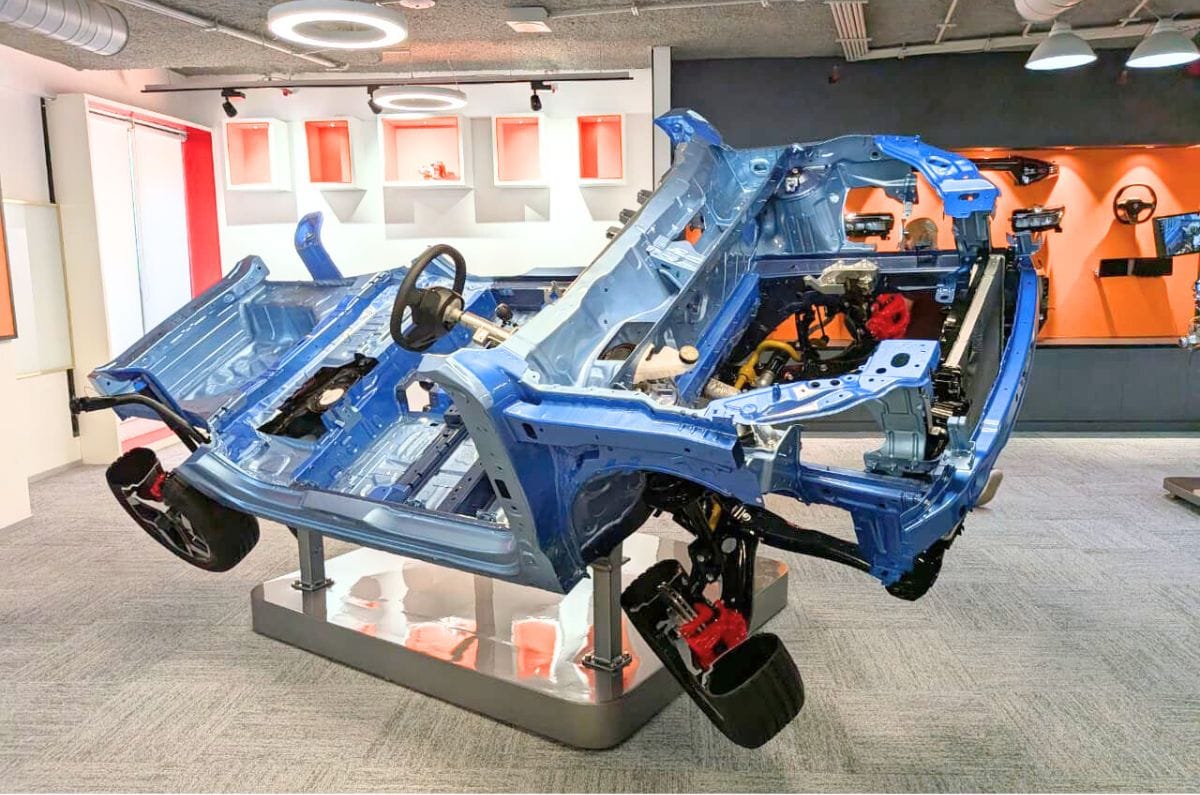
Unveiling the Enigma: Demystifying Renault Duster's RGMP and CMFB Platforms – A Deep Dive into Automotive Architecture
The Platform Paradox: RGMP vs. CMFB - More Than Just a Name?
Electrifying the Nervous System: Renault's SWEET400 & Google Automotive System
Tailoring for Markets: The Sub-4-Meter Imperative
Future-Proofing Powertrains: The Electrification Edge
Beyond the Bones: The India-Specific Duster's Unique Identity
RGMP vs. CMFB: A Strategic Comparison (Pros & Cons)
Renault Global Modular Platform (RGMP)
Common Module Family – B (CMFB)
Conclusion: A Strategic Evolution, Not Just a Rebranding