
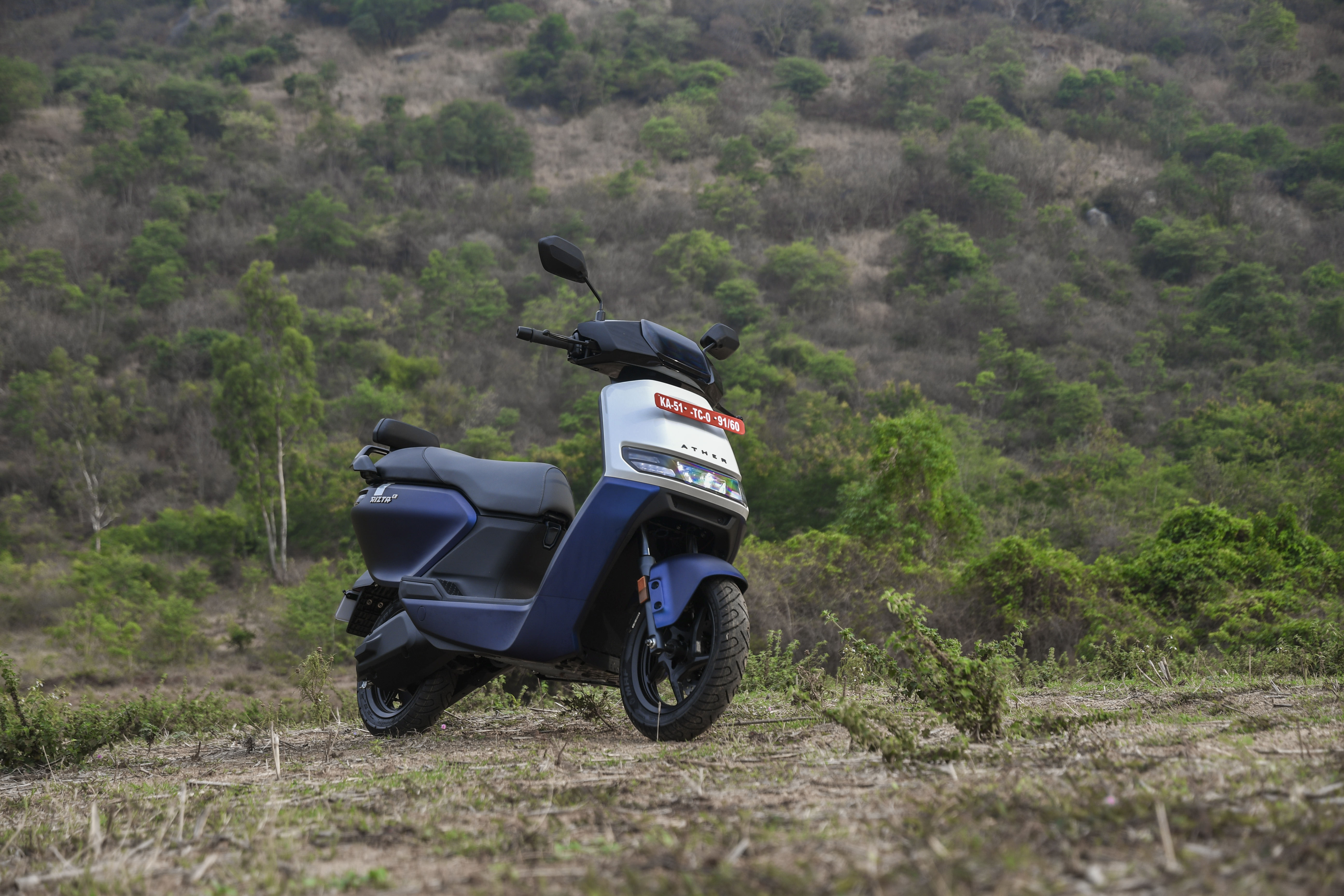
The electric scooter market in India is a battlefield of innovation, aspiration, and often, compromise. Amidst this vibrant landscape, Ather Energy, a name synonymous with performance and smart technology, introduced the Rizta in 2022. Pitched as a \"family-centric, practical offering,\" it aimed to carve a niche beyond the sporty prowess of its elder sibling, the 450 series. But with two variants and two battery pack options, which one truly delivers on its promise of accessible electric mobility for the masses? Today, we're diving deep into the most affordable iteration – the Ather Rizta S 2.9kWh. Is this entry-level model a strategic masterpiece, or does its cost-saving approach leave crucial features wanting? Let's peel back the layers and uncover the truth behind Ather's bid for the family scooter crown. Beneath the Rizta’s approachable exterior lies a motor designed for efficiency and everyday urban usability rather than outright thrills. The Ather Rizta S 2.9kWh, like all its siblings regardless of variant or battery size, is equipped with a motor that delivers a peak power of 4.3kW (approximately 5.7 hp) and a peak torque of 22Nm. These figures might not set the track alight, but for navigating congested city streets and ferrying a pillion, they are more than adequate. In its spirited 'Zip' mode, the Rizta S 2.9kWh can achieve a top speed of 80kph. This speed is perfectly respectable for intra-city commutes and allows it to keep pace with traffic without feeling overwhelmed. While some might crave higher top-end performance, especially those accustomed to petrol scooters, it's crucial to remember the Rizta's primary objective: practical, efficient family transport. The consistent power output across the entire Rizta lineup simplifies the decision-making process for consumers, ensuring that even the base model offers the same fundamental riding experience in terms of acceleration and speed. From zipping through traffic to climbing moderate inclines, the Rizta's powertrain offers a smooth and predictable response, a characteristic feature of well-tuned electric vehicles. The instant torque delivery inherent in electric motors ensures brisk off-the-line acceleration, making it ideal for quick overtakes in city limits. While it might not match the raw acceleration of its sportier counterparts like the Ather 450X, it delivers a comfortable and confident ride, which is precisely what its target demographic needs. Range is arguably the most critical factor for potential EV buyers, and it's here that the choice of battery pack becomes pivotal. The Ather Rizta S comes with a 2.9kWh battery pack, a smaller sibling to the 3.7kWh option available on higher variants. Ather claims an IDC (Indian Driving Cycle) range of 123km for the 2.9kWh variants, while the larger 3.7kWh pack boasts an IDC range of 159km. However, IDC figures, while useful for standardized comparison, often paint a rosier picture than reality. In the trenches of real-world riding, where traffic, varying speeds, rider weight, and terrain all play a part, our long-term testing with a Rizta Z featuring the smaller 2.9kWh battery pack revealed a true-range of approximately 105km. This is a significant, albeit expected, drop from the IDC figure. For daily commutes within a city, 105km is often sufficient, covering a week's worth of typical usage for many riders. However, for those with longer commutes or who frequently make multiple trips in a day, this figure necessitates careful planning and consistent charging. The \"range anxiety\" often associated with EVs can certainly creep in, especially on days when the battery gauge dips lower than expected. The distinction between claimed IDC range and real-world range is a common point of contention in the EV space, and the Rizta is no exception. While 105km is practical, it means riders should mentally adjust their expectations downwards from the advertised numbers. This pragmatic real-world range, while not groundbreaking, positions the Rizta S 2.9kWh as a viable option for urban families who understand the nuances of EV ownership and are willing to integrate charging into their routine. When it comes to electric vehicles, charging time is as crucial as range. For the Ather Rizta S 2.9kWh, home charging remains the primary method, and Ather provides a dedicated home charger for this purpose. The company states a 0-80 percent charging time of 6 hours and 30 minutes using this standard charger. To reach a full 100 percent, an additional 2 hours are required, bringing the total charging time from empty to full to approximately 8 hours and 30 minutes. These charging durations mean that overnight charging is the most practical solution for most users. Plugging in the scooter before bed and waking up to a fully charged vehicle fits seamlessly into many lifestyles. However, if you forget to charge or have an unexpected mid-day need for a long ride, these times can be a significant drawback. Unlike quick petrol fill-ups, an EV demands foresight and planning, especially with a battery of this size and a standard charger. While Ather also operates its expansive Ather Grid public charging network, the S variant's charging speed doesn't leverage the full potential of fast chargers as effectively as some premium EVs, though access to rapid top-ups is certainly a convenience for emergencies. The relatively long charging time could be a sticking point for potential buyers coming from petrol scooters who are used to instant refuels. It underscores the need for a paradigm shift in thinking about \"fueling\" your vehicle. For many, the ability to charge at home eliminates frequent trips to petrol pumps, but it introduces a different kind of time commitment. This is where the balance between affordability and convenience is constantly being weighed in the EV market. Perhaps the most significant differentiator between the Ather Rizta S and its more premium Z variant lies in their feature sets. This is where Ather has made conscious choices to keep the 'S' model accessible, but at what cost to the user experience? The Rizta S variant, staying true to its essentialist philosophy, is equipped with a basic LCD display. This display offers fundamental connectivity features, navigable via a simple 4-way joystick. It’s functional, displays critical information like speed, range, and battery status, and gets the job done. However, stepping into the Z variants reveals a stark contrast. These models boast a vibrant 7-inch colour TFT touchscreen display. This isn't just a screen; it's a gateway to an enhanced digital experience, supporting Google Maps navigation, WhatsApp message previews, digital document storage, and comprehensive Bluetooth connectivity through the Ather app. This suite of features transforms the scooter into a truly \"smart\" device, aligning with modern expectations for connected vehicles. Beyond the display, the Z variants also benefit from several performance and comfort upgrades:
The absence of these features on the S variant is a calculated compromise. While the LCD is functional, many modern buyers, especially those familiar with Ather's tech-forward image, might feel short-changed without the full suite of smart features. The lack of traction control, for instance, could be viewed as a safety concern for a vehicle targeting families, where diverse riding conditions are common. This is a clear case where the \"negative view PR\" angle arises: is stripping down these features for a lower price truly serving the \"family-centric\" ethos, or just creating a more bare-bones experience that misses key advantages of EV technology? Ultimately, the decision often comes down to the bottom line. The Ather Rizta S 2.9kWh is positioned as the most accessible entry point into the Rizta family. It starts at an ex-showroom price of Rs 1.15 lakh in Bengaluru. In contrast, the higher-spec Rizta Z model with the same 2.9kWh battery pack demands a price of Rs 1.32 lakh (ex-showroom, Bengaluru). This represents a premium of Rs 17,000 for the Z variant. Is that Rs 17,000 premium justified? For an additional sum, buyers of the Z variant gain:
Considering the significant improvements in both smart features and rider/pillion comfort and safety, the Rs 17,000 price difference feels justifiable for many. For a scooter marketed as \"family-centric,\" the additions on the Z variant, especially the backrest and traction control, align more closely with the stated philosophy. The S variant, while cheaper, feels more like a basic commuter, potentially compromising on the very aspects that would make it a superior family vehicle. This price differential puts the Rizta S in a direct battle with other entry-level and mid-range electric scooters from competitors, where its \"stripped-down\" nature might become a disadvantage against rivals offering more features at similar price points. The Ather Rizta S 2.9kWh is an intriguing proposition. It is Ather's earnest attempt to democratize electric mobility, bringing the brand's engineering prowess to a wider, more family-oriented audience at a competitive price point. On its own merits, it offers reliable urban performance, a decent real-world range for most daily commutes, and the core benefits of EV ownership like low running costs and silent operation. However, its \"S\" designation truly signifies \"Simplified.\" The conscious removal of premium features, while lowering the sticker price, also strips away some of the innovative aspects that make Ather scooters so compelling. The lack of a vibrant TFT display, advanced navigation, traction control, and a pillion backrest might leave some buyers questioning the \"family-centric\" claim. For a mere Rs 17,000 more, the Rizta Z 2.9kWh offers a significantly more complete package, addressing many of these perceived shortcomings with crucial comfort and safety enhancements. This makes the Z variant arguably a better value for the target audience looking for a genuinely feature-rich family EV. So, who is the Rizta S 2.9kWh for? It's for the pragmatic buyer, the individual or small family with a strict budget, whose daily commute falls comfortably within the 100km mark, and who prioritizes core electric functionality over smart features. If you view a scooter primarily as a utilitarian tool to get from A to B efficiently and silently, and are willing to forgo advanced tech for affordability, the Rizta S could be a sensible choice. It's a reliable workhorse, not a tech-laden show pony. But for those who desire the full Ather experience, with its cutting-edge connectivity, enhanced safety features, and superior passenger comfort, the smart money might be better spent on the Z variant. The Ather Rizta S 2.9kWh is a commendable step towards making EVs more accessible, but its true challenge lies in convincing buyers that its compromises are justified, particularly when a more complete, albeit slightly pricier, option exists within its own stable. The future of family electric scooters isn't just about range and price; it's about delivering a holistic, safe, and integrated experience, and the S variant still has a few miles to go to fully embrace that ethos.Ather Rizta S 2.9kWh: Unpacked – Is India's Family Electric Scooter Truly a Game Changer, or Just Another EV?
Powering the Commute: Performance and the Daily Grind
Addressing Range Anxiety: Battery Performance and Real-World Usability
The Charging Conundrum: Time, Convenience, and the Ather Grid
The Feature Divide: S vs. Z – Stripped Down or Smartly Essential?
The Price Point: Value Proposition and Market Positioning
Ather Rizta S 2.9kWh: Pros and Cons
Pros
Cons
The Verdict: Is the Ather Rizta S 2.9kWh Your Next Family EV?